Generative engine optimization makes your site readable, quotable and trustworthy for ChatGPT, Perplexity, Gemini and Google's AI Overviews — and RankWay does the work every week.
Get full access: keywords, content, AI visibility, backlinks, leads — fully automated.
Start 7-day free trialTrusted by brands and agencies around the world



Four building blocks decide whether a language model can — and wants to — quote you.
llms.txt, JSON-LD schema and clean heading hierarchies, so models can extract your statements instead of guessing.
Retrieval starts with search: pages that rank get retrieved, pages that get retrieved get quoted.
Articles that answer a question completely, with facts, numbers and sources — the format models prefer to cite.
References on sites and directories these systems trust. External evidence outweighs your own claims.
Decide which AI crawlers may read your content — and make sure the ones you want are not blocked by accident.
Business profile, directories and consistent data, so local recommendations name you.
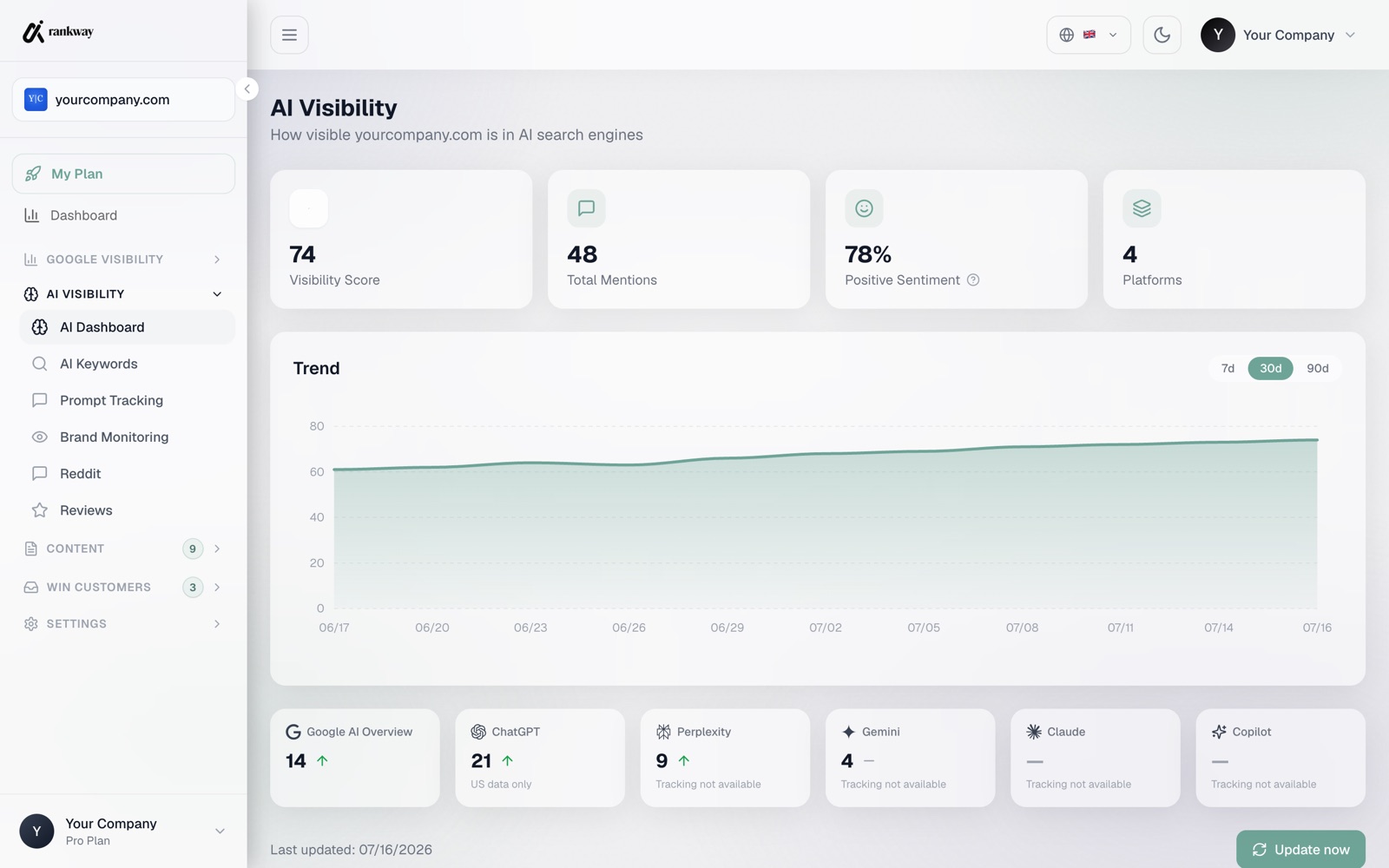
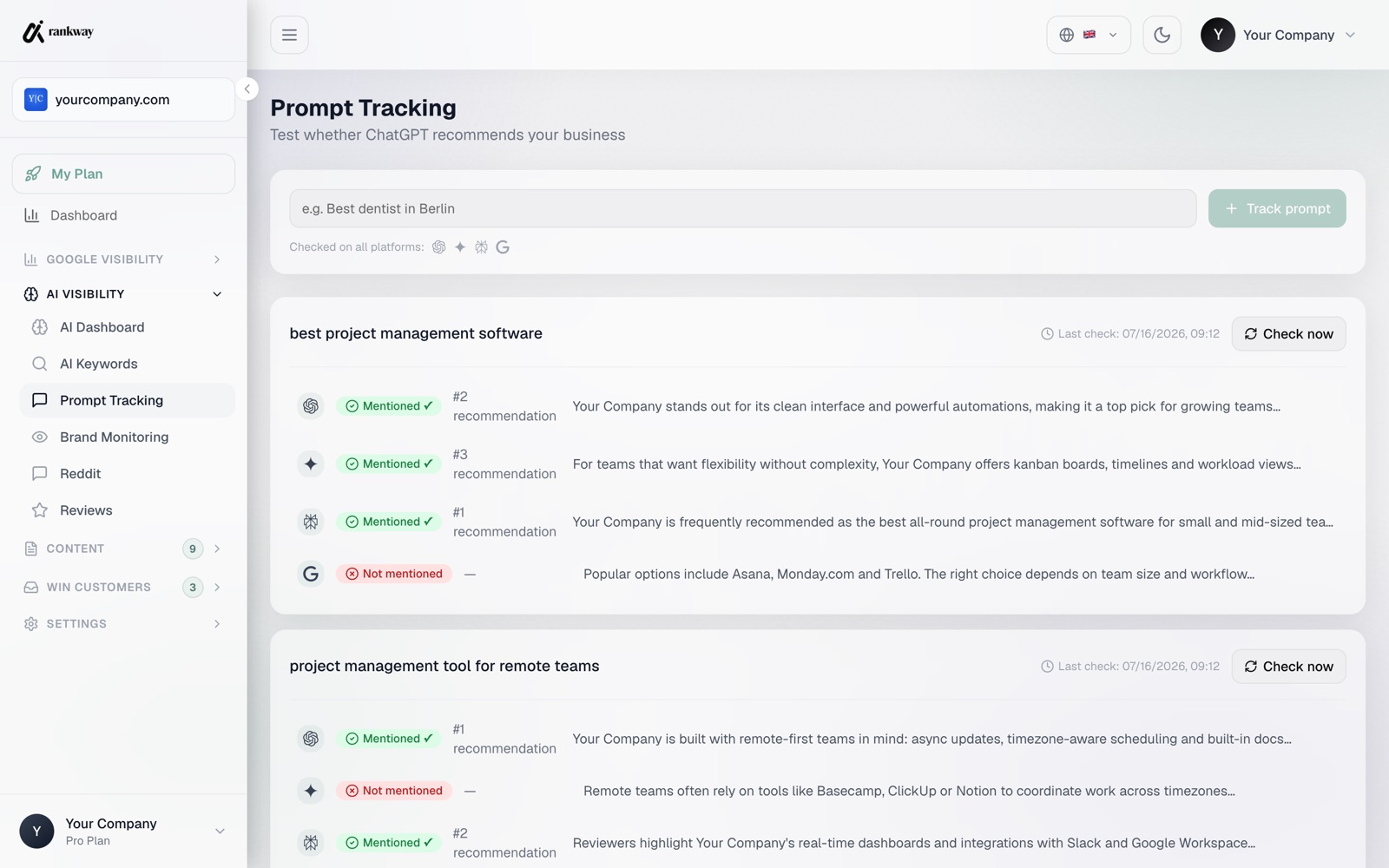
GEO without measurement is guesswork. RankWay tracks which prompts mention you, which sources AI answers cite, and how your share of voice develops — before and after every change.
Generative engine optimization (GEO) is the practice of making a website the kind of source that generative AI systems quote. Where classic SEO optimizes for a ranked list of links, GEO optimizes for a single synthesized answer — and that answer names only a handful of providers.
The two disciplines are not alternatives. Language models retrieve what search engines already rank, then decide which of those sources to reference. That means GEO optimization builds directly on solid SEO — without rankings there is nothing to retrieve, and without citability the retrieval doesn't turn into a mention.
Want to know where you stand before you start? Run the free AI visibility checker, or see how brand mention tracking works. If you would rather have it handled, that is what RankWay automates — see plans and pricing.
Two more pieces of the same puzzle: what a ChatGPT SEO tool actually measures, and how backlink exchange builds the references models trust.
GEO stands for generative engine optimization: making your website the kind of source that ChatGPT, Perplexity, Gemini and Google's AI Overviews quote in their answers. It combines technical readability (llms.txt, structured data), answer-shaped content and external trust signals.
SEO optimizes for a ranked list of links, GEO for a single synthesized answer. They build on each other: language models retrieve pages that already rank well, so GEO without a solid SEO foundation has nothing to work with.
llms.txt is a file in your website root that tells language models which content matters and how it is structured — comparable to robots.txt for crawlers. It is not yet an official standard, but it is cheap to add and already read by several systems. RankWay generates and updates it for you.
Model answers update continuously, so changes can appear within weeks — much faster than classic ranking improvements. The prerequisite is that your pages rank well enough to be retrieved in the first place, which is where the timeline of classic SEO applies.
Yes — structured data, clean headings and an llms.txt file are all doable manually. What is hard to do by hand is the measurement: checking dozens of prompts across four platforms every day, and tracking which sources get cited. That is the part RankWay automates.
Millions ask AI for recommendations every day. Find out in 30 seconds whether you show up — free, no signup.
Check for free →