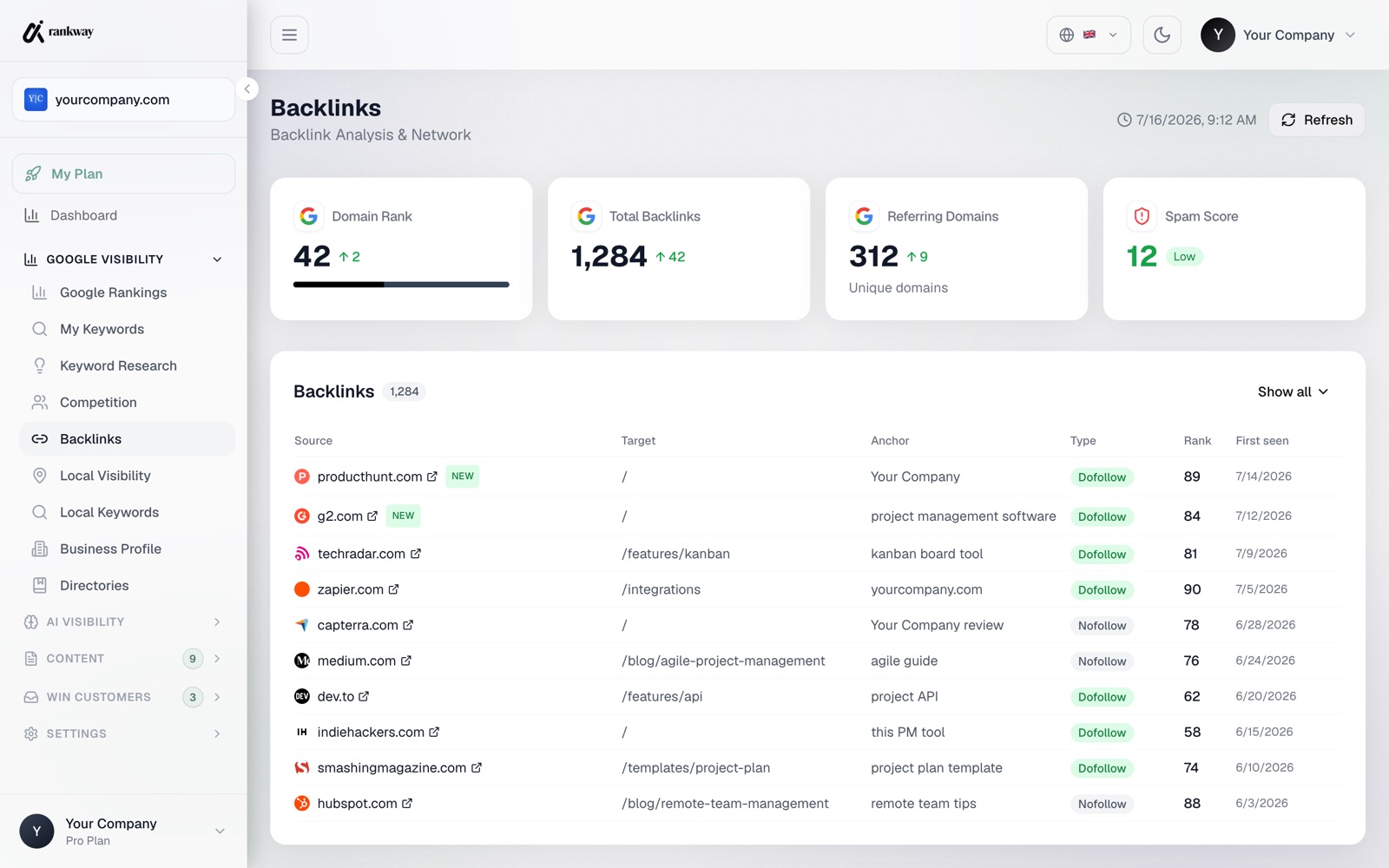
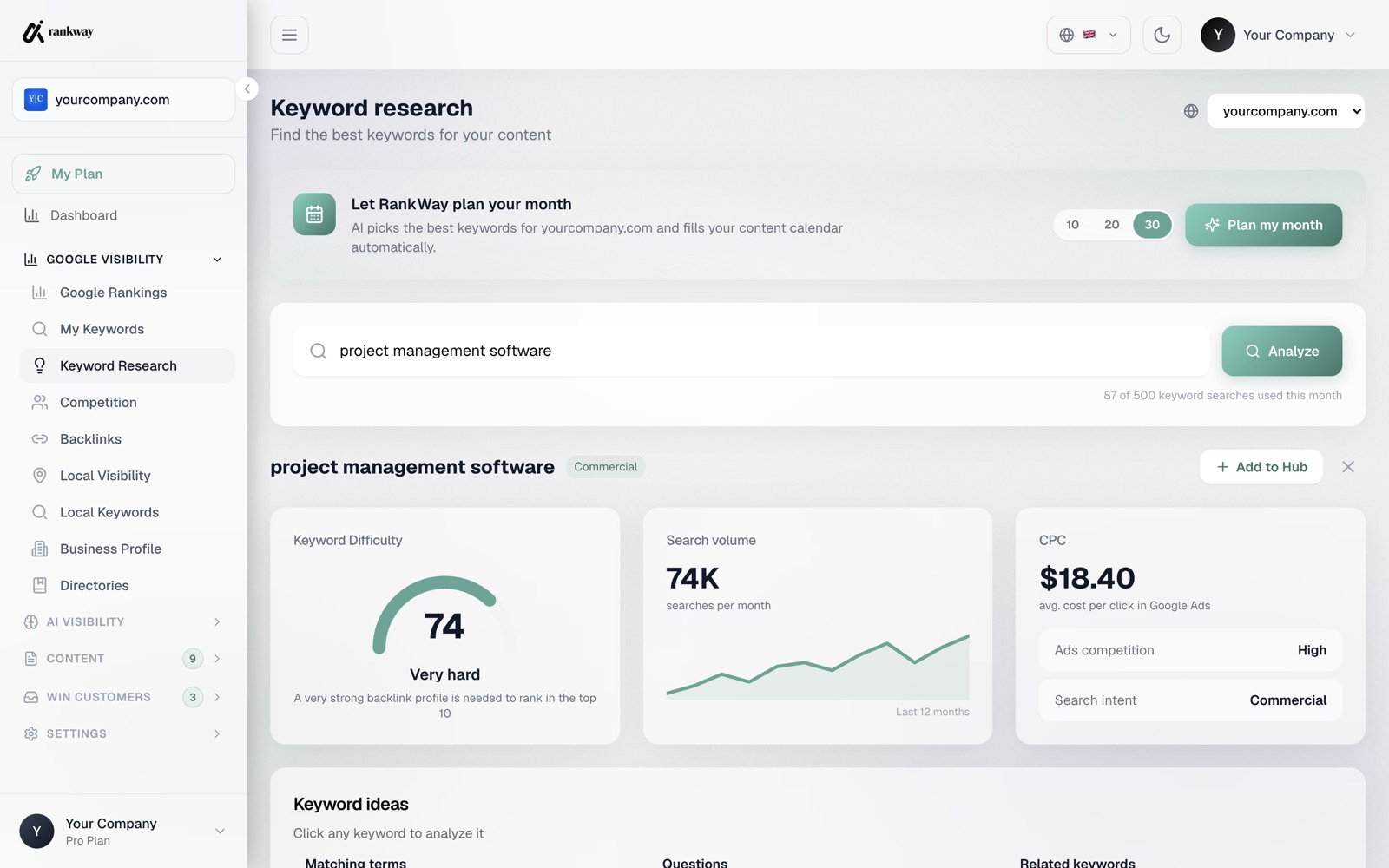
Get matched with sites in your language and industry, place the links, and let RankWay verify every one of them in the live HTML — with a re-check every 30 days.
Get full access: keywords, content, AI visibility, backlinks, leads — fully automated.
Start 7-day free trialTrusted by brands and agencies around the world


The reason link swaps get devalued is the pattern, not the principle. Matching fixes the pattern.
Partners are selected by language and industry, and rotated — so the same two domains don't keep linking to each other.
A daily job fetches the published URL and checks whether your link is really in the HTML. Removed links are flagged, not assumed.
A limit on how many links one site can receive keeps the profile natural instead of building a visible network.
Most exchanges end when the link is placed. That is exactly when the problem starts: pages get edited, redesigned, or quietly stripped of outbound links.
Reciprocal linking has a bad reputation, and some of it is earned. What Google devalues is the footprint: two sites linking to each other repeatedly, in the same place, with the same anchor, on pages that exist only to hold links. What it does not devalue is a relevant link on a real page that a real reader might follow.
So the question is not whether to exchange links, but whether the exchange leaves a pattern. Rotation across a pool of partners, matching by language and industry, a cap per recipient, and links inside genuine articles — that is the difference between link exchange that works and one that gets discounted.
Links also feed AI answers: assistants lean on sources that others reference, so a healthy backlink profile shows up in GEO optimization too. Check where you stand with the free AI visibility check, or see what is included on the plans page.
Two websites agree to link to each other, usually from within relevant articles. Done carelessly it leaves an obvious reciprocal pattern; done with rotation across a pool of partners and genuine placements, it is a normal way to earn links.
Excessive reciprocal linking purely for ranking purposes is a link scheme. A relevant link on a real page that serves readers is not. The distinguishing factor is scale, pattern and whether the page exists for people or only for links.
By language and industry, with rotation so the same two domains don't repeatedly link to each other, and with a cap on how many links a single site can receive. That keeps the resulting profile varied rather than networked.
A daily job fetches the published URL and looks for your link in the live HTML. If it disappears, the link is marked as removed instead of silently counting toward your total. Every link is re-checked roughly every 30 days.
Yes, indirectly but clearly. Assistants tend to retrieve and cite sources that rank well and are referenced by others, so links remain one of the signals behind whether a model treats your site as a credible source.
Millions ask AI for recommendations every day. Find out in 30 seconds whether you show up — free, no signup.
Check for free →